Historic Burgers at Hamburger America

New York is a city of viral sandwiches where every week, scores of locals and tourists line up for the latest one. Whether it’s a crispy chicken sandwich currently trending on tiktok, bánh mì hailed by culinary media as the best on the east coast, or unique items like Jamaican Patties sliced open and stuffed with oxtail, there’s always something interesting worth joining a queue that goes around the block. Hamburgers are among the most successful of these trendy sandwiches; from the Ramen Burger that became a viral sensation alongside the Cronut in 2013, to the infamous Wagyu Burger from Sip & Guzzle that retails for the same price as ten Big Mac combos.
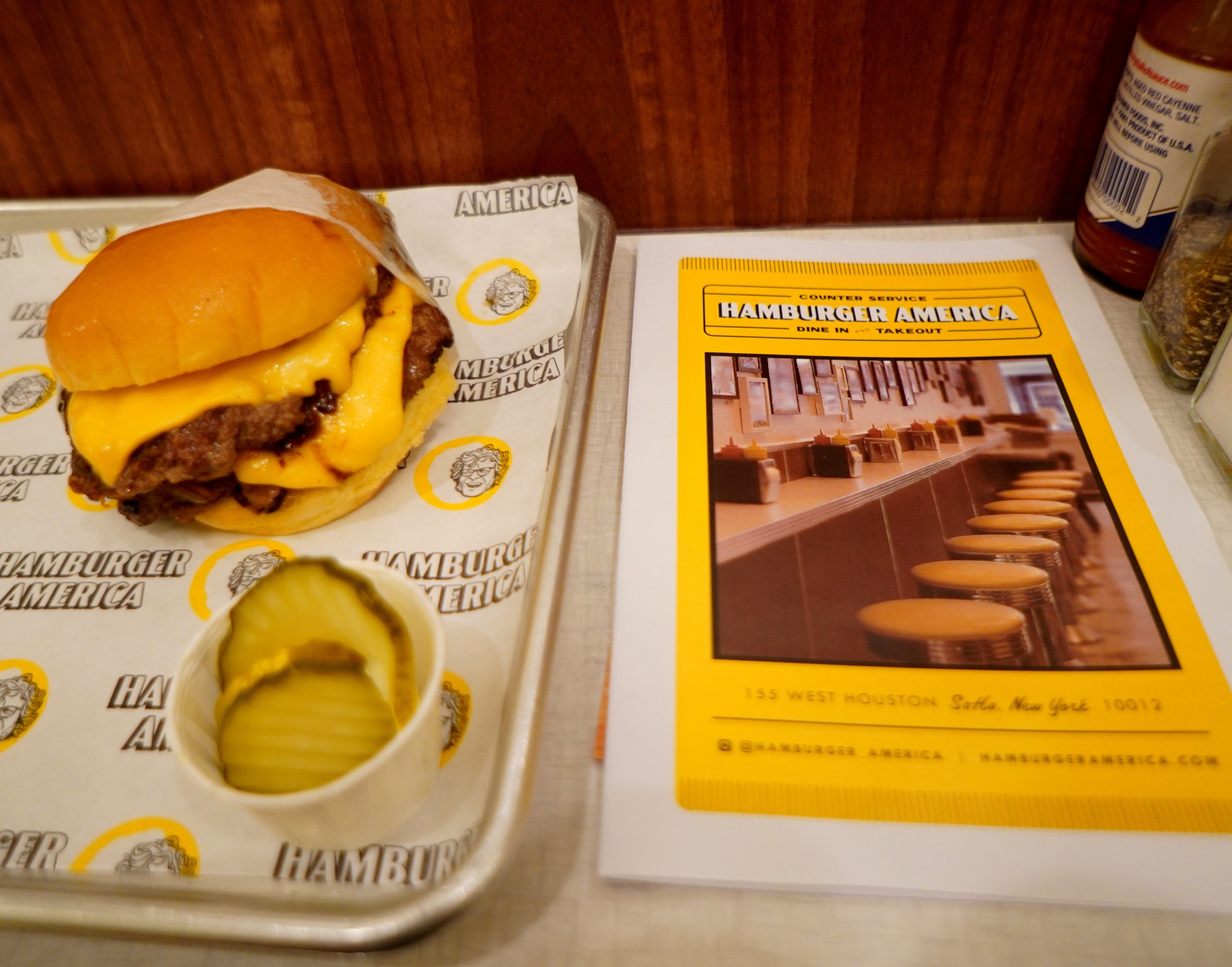
A viral burger in New York City has the potential to change the trajectory of any chef’s career, and many experiment with luxury ingredients like truffle mayo, aged cheddar or Kobe beef to set their hamburger apart. At the other end of the spectrum is Hamburger America, a luncheonette-inspired restaurant on the corner of Houston and Sixth Avenue that has earned a reputation for the best burgers in New York City while serving what are essentially Depression-era hamburgers.
The story of Hamburger America started in 2004 with a documentary of the same name by George Motz followed by two books and a TV series that featured over a hundred iconic American burgers. A restaurant that pays tribute to the history of the American hamburger seemed like the next step, so after a series of successful pop-ups, and investment from some business partners; Motz created Hamburger America. The restaurant’s retro-inspired interior and bright colors are a clear homage to the classic hamburger joints that Motz documented over his career as a hamburger historian. Along the walls are framed articles by and about Motz, as well as posters for past events like burger pop-ups and book signings.

The standard cheeseburger at Hamburger America is a smash burger with diced onion, dill pickles, mustard, and American cheese served on a buttered and toasted potato bun. It’s a straightforward burger that is supposed to be like the simple burgers sold all across America before cheap fillers and frozen beef became standard ingredients in burger patties. It’s similar to the burgers served at regional chains like In-N-Out and Culver’s that are cooked to order using freshly prepared ingredients.
More interesting, is their take on the Fried Onion Burger, which was invented in El Reno, Oklahoma during the Great Railroad Strike of 1922 when a chef added equal parts onions and beef to a grill in order to stretch his supply of meat. It caught on with customers and became an Oklahoma specialty as it spread across the state during the Great Depression. This type of burger stands out from other burgers topped with cooked onions due to how it’s prepared, and at Hamburger America it’s possible to be take a seat at a stool across from the grill and observe them being prepared across the counter.

Thinly sliced onions are generously spread on a ball of beef that is sizzling on the flattop grill, then smashed with a spatula. After it’s smashed, the onions on the side of the patty are now in direct contact with the flattop and they begin to caramelize and char. The onions in the center remain light colored as they sizzle and soften in the cooking liquid on the beef patty. All of the onions are piled on top, and it’s then flipped and topped with cheese. Instead of toasting the hamburger bun, it’s placed on top of the onions and beef and steamed by the liquid that evaporates.
The flavor of sweet, caramelized onion dominates, but there is also some pungency from the slightly less cooked onions, and bitterness from the pieces that are more burnt. Motz says that onions were the first condiments on a burger, and the Fried Onion Burger shows how much complexity they can bring, and how well they complement cheese and beef.
An attraction of Hamburger America that keeps people coming back is the rotating roster of regional burgers from places that Motz has visited. It gives diners a chance to step back in time and sample a burger that’s no longer made the same way, or to have an iconic burger from rural America complete with bread and condiments that Motz has specially brought in for the occasion.
The Slugburger is a specialty of northern Mississippi that’s named after a slang term for a five cent piece since that’s what they cost in 1917 when they were invented. The inventor of this budget burger used potato and flour as fillers in the ground beef, but as it caught on, cooks also started using soy grits and breadcrumbs. Motz uses crumbs from hoagie rolls, and serves the burger on a toasted slider bun with diced onions and mustard in order to keep it authentic to the Slugburgers of over a century ago. The breadcrumbs make the edges crispy, and it’s reminiscent of Arabian kibbi in terms of texture and flavor.

Unlike the Slugburger and Fried Onion Burger that are no longer made at the places where they were invented, the Cheesy Western is still a hometown hit at the Texas Tavern in Virginia. Motz went on a road trip to pick up the housemade cabbage and mustard relish that makes this burger special. The relish is liberally spread across the top bun along with thinly sliced onions and two pickles. On the bottom bun there are two griddled patties that are topped with cheese and an egg that’s whisked ten times and cooked sunny side up. It’s unknown exactly how eggs became a part of this burger, but it is likely it was added alongside the relish as a way of making the burger look bigger and seem like better value for customers without using additional meat.

There are some interesting contrasts in the Cheesy Western. The ingredients placed on the bottom bun are all hot, tender, and almost creamy with richness, while the ingredients that were placed on the top bun are all cold, crunchy, and tart. These cold ingredients help to cut the richness of the meat, eggs, and cheese while also introducing some interesting contrasts and flavors. Its status as an iconic American burger is due to not only its longevity, but its unusualness. The regional burgers on the menu change every month, so visiting New York City at the right time gives an opportunity to try two regional burgers, as well as the regular burgers at Hamburger America.